


A story can enter our awareness from different directions no matter the theme, vantage point, or the observer’s perspectives. The compass points I have chosen to be my guide come from the forgotten or lesser-told stories of aviation history. Much of the reasearch I have already conducted is derived from military resources. But much of this had its origins in the realm of civilian aviation.
The Civilian Pilot Training Program
From its inception in February 1939 through June 1941, the CPTP produced a vast reservoir of trained pilots. Of the 907 program centers, 707 were located at colleges and universities.1 Western State Teacher’s College in Kalamazoo (which later became renamed Western State College of Education) sponsored one of these programs. Theirs began in 1939 along with the establishment of a new two-year vocational aviation mechanics school that was also linked to the newly formed CPTP.2 The inaugural program in the fall of 1939 enrolled fifty-nine students. Flight training was conducted at Lindbergh Field (later renamed Kalamazoo Airport) or the nearby Austin Lake Airport. The requirements to enter the CPTP were passing a flight physical exam and producing $20.00 for insurance and $4.50 for textbooks. The first level, or elementary CPTP course, included 35 to 50 hours of primary flight training, both dual and solo in the Piper Cub at a local airport and 72 hours of ground school at a college.
By 1940, general aviation was entering what was known as the ‘Classic’ period. “It was the heyday for the Piper Aircraft Corporation who perfected its J-3 Cub into one of the most recognizable icons in aviation history and became the company’s biggest success. The need for new pilots led the government to turn to aircraft manufacturers, like Piper, to build primary trainer aircraft. The Piper J-3 Cub, which was produced as the L-4 Grasshopper for military purposes, became synonymous with the war effort, specifically after the CPTP was rolled out.”3 This venerable J-3 Cub became the standard training aircraft of the CPTP training fleet. It was a relatively affordable, lightweight, high-winged cabin monoplane. “The demand was so astounding, it seemed that Piper Aircraft could not churn the J-3 out fast enough. Before long, a J-3 Cub was rolling off the line every 20 minutes. Piper claimed that more than 80 percent of the light aircraft used in the early days of the CPTP were Cubs.”4
At the end of the course, those students who satisfactorily completed a written exam and a check flight with a CAA inspector earned a private pilot’s license. No military obligation would be assumed at that time, but many graduates eventually went into the Army or Navy.5,6 Secondary courses consisting of an additional 108 hours of ground school and 40 hours of flight training in more-powerful Waco trainers taught advanced aerobatics and cross-country navigation.7
It was claimed the CPTP failed to produce sufficient candidates or adequately prepare them for military aviation. Initially, the percentage of CPTP students who entered the nine primary flight training courses offered by the Army Air Corps in 1941 and 1942 was low compared with the number of students not from the CPTP who entered the same courses. However, a higher percentage of CPTP-trained students (88.2%) were likely to finish the course compared with those not CPTP-trained (56.6%). It was concluded the CPTP was a qualitative rather than a quantitative success.8 When the United States entered WWII, the nature of the CPTP changed entirely. On December 12, 1941, Executive Order 8974 officially transformed the CPTP into a wartime program. All CAA civilian pilot training efforts would be exclusively devoted to the procurement and training of men for ultimate service as military pilots.
1. Mingos H. (Editor) (1941). The Aircraft Yearbook for 1941. Aeronautical Chamber of Commerce of America, Inc. pp. 100-101. 2. Thinnes T (Sr), Jones S, Sinclair G, Thompson R. (2014) Ascending Higher: The Story of Aviation at Western. pp. 13-17. 3. Chilsen H. “From the Ground Up.” EAA Sport Aviation Magazine. Vol. 72, No. 12, December 2023, p. 48. 4. Ibid. 5. Pisano DA. “To Fill the Skies with Pilots: The Civilian Pilot Training Program, 1939-46.” (1993). University of Illinois Press, p. 67. 6. Newark Engineering Notes (December 1941). Civilian Pilot Training Program and National Defense. Newark College of Engineering, Volume 5, No. 1, p. 19. 7. Ibid. 8. Bishop MG. (October 1940). “Pilots Needed.” Flying and Popular Aviation, Volume XXVII, Number 4. pp. 20-22.
Comments to “CPTP” Post
The Airway Beacon System
Beginning in the 1920s, aviation was in competition with the railroad for fast and efficient delivery of mail. The problem with air mail was, nightime grounded pilots and delayed delivery. The railroads maintained their status of being more efficient for transporting mail. Taking a cue from coastal navigation lighthouses, a system of beacons was eventually established across the united states to guide pilots around-the-clock.
In 1923, to make night flying safer, the US Post Office Airmail Service began experimenting with building a series of bright rotating light beacons, each on a 53-foot high tower placed about 10 miles apart, to create an airway route from Cheyenne, Wyoming, to Chicago, Illinois. This particular section was chosen first partly because of its relatively flat terrain and proximity to commercial electrical power.
This experiment marked the birth of the Airway Beacon System visible to pilots flying at night. The spacing was closer in the mountains, and farther apart in the plains. Beacons rotated at six revolutions per minute, flashing every ten seconds for one-tenth of a second. With approximately 1,000,000 candlepower, the beam was elevated about one degree above the horizon and could be seen at a distance of 40 miles on a clear night.
Some beacons were even equipped with an auxiliary light that projected a specific course code onto the ground, allowing pilots to identify their location along the route. Other beacons incorporated two course lights mounted on a 6-foot square maintenance platform: one pointing forward and the other backward along the airway. Equipped with red or green lenses, the course lights indicated the presence of a beacon only (red) or a landing field within two miles of the beacon (green). Amber colored course lights denoted a landing field suitable for daytime operations only. The course lights flashed out a system of codes, which allowed the pilots to determine their mileage along the airway.

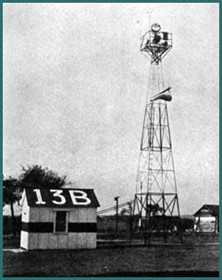
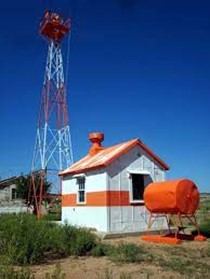
Thus began the Transcontinental Airway System that extended from New York City to San Francisco. With the passage of the Air Commerce Act in 1926, the Transcontinental Airways System was transferred from the Post Office to the Bureau of Lighthouses. By 1933, this navigational aid system consisted of more than 1,500 beacons spread across approximately 18,000 miles of airways, guiding pilots safely through the skies at night. Supplementing the beacon system were intermediate landing fields every 30 to 50 miles to provide a haven in the event of difficulties. Westbound airmail flights could now traverse the continent in 34 hours, while eastbound services, with their prevailing tailwinds, took only 29 hours, besting the railroads by some two days. An eastbound departure from San Francisco could land in Cheyenne before dark.

To supplement the rotating beacons and other landmarks, large concrete Directional Arrows were introduced around late 1926 or early 1927. These arrows were built only as daytime visual aids: Their effectiveness was limited by visibility and weather conditions.

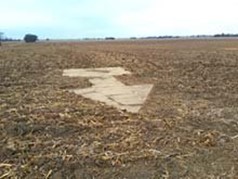
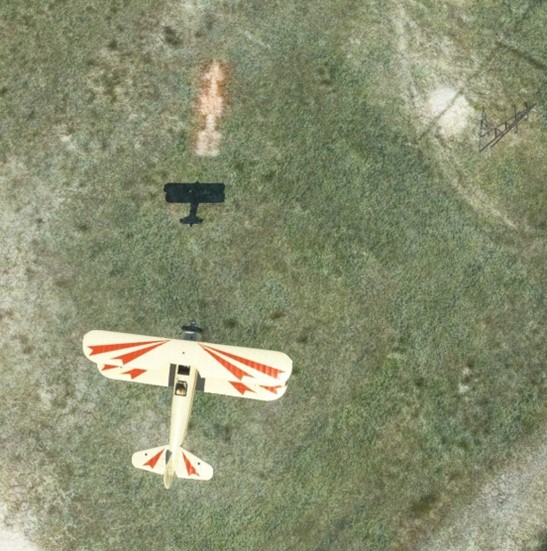
These fifty-plus-foot concrete day-marker arrows pointed to the next higher numbered beacon—i.e., the next beacon toward the east. These were originally painted chrome yellow with an 8-inch black border. During the night, this arrow was lit from above by high intensity lights mounted on the beacon tower frame. At the “feather” end of the arrow was a power shed housing a generator if no local power was available. On the roof of the power shed was painted the airway route and the beacon site number.
As America began preparing for war in the late 1930s, the number of airway beacons continued to increase, peaking by the end of 1941 and remained relatively constant from year to year for the duration of the war.
WWII resulted in an immediate and massive increase in air traffic from coast to coast. This included unprecedented levels of military flight training, as well as the movement of personnel and materiel on a grand scale. The light beacons remained indispensable for military night navigation throughout the war. Between 1940 and 1945, there were more airway beacons operating in the U.S. than at any other time in history.
 Bearss-Lair Books
Leave a comment